An adult wizard grappling with the abnormal interrupting a normal world, that's Harry Dresden for you. He thinks and talks like a wisecracking world-weary detective in the Philip Marlowe mould. But he stands out by being the only one of his kind, a wizard private detective sniffing the mean streets of Chicago.
Thanks to HRV's book investigating skills, I got to devour the first book in Jim Butcher's Dresden Files series. It was a good change to read a fantasy novel populated by adult wizards, after Harry Potter, Narnia and the Dark Materials trilogy. And the murders are as brutal as it can get, starting with two human hearts ripped off their bodies.
Dresden's special powers make him the archetypal misfit. His magical power ensures that modern implements quail at his touch, ranging from telephones to elevators. The flip side, he struggles to use them when most needed. The police take his help, but regard him with a mixture of suspicion and disdain.
Too involved in human concerns, Dresden does not cut much ice with the wizard world too. All in all, it's a tightrope walk throughout.
But in a cruel and cynical world, Dresden keeps humanity alive.
The successful book series was spun into a TV series earlier this year but failed to make a mark. Harry Dresden's role is essayed by a certain Paul Blackthorne (remember the arrogant Captain Russell of Lagaan)
Showing posts with label Books. Show all posts
Showing posts with label Books. Show all posts
Tuesday, November 06, 2007


Sunday, August 05, 2007
THE ART OF OSAMU TEZUKA
All I knew about Japanese comics or manga was that they were violent, with blood spilt left, right and centre. Something very `underground'. And a breed of violence which could also be balletic in its execution. Sample Quentin Tarantino's Kill Bill and O-Ren Ishii or Cottonmouth, played by Lucy Liu, in the first part.
And then came the Buddha, an eight-part graphic novel series by Osamu Tezuka. An epiphanic experience for me, who had thought Japanese works were all about blood. Here was the life story of the Buddha told for an adult. A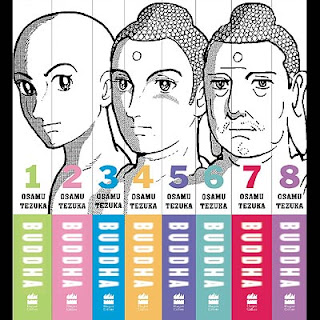 giant leap from the world of Amar Chitra Katha, my previous window to Buddha. And figures from history made the transition from black or white to grey.
Tezuka depicts a Siddhartha battling with himself and striking free of his inner turmoil, while carving out His Path. And his teachings are visualised beautifully, through tales such as Sebu the Ox.
Unlike an Amar Chitra Katha which condensed into one Buddha's life and teachings, eight long parts gives enough and more space for other characters to stamp their presence. And Tezuka brazenly takes liberties with history, fictionalising the journey of known characters like Devadatta, Bimbisara and Ajatasatru and bringing in his own creations like Chapra, Tatta, Bandaka and Migaila. Animals too make it as flesh-and-blood characters.
At the same time, violence too finds a place with different characters either succumbing to it or overcoming the need for it. And the author reminds us of the Asterix series by making his characters spout contemporary references. There's also the occasional four-letter word. Tezuka also tries out self-deprecatory humour, with digs aimed at himself.
Here are two 'magnum opus' works, Buddha and the Phoenix, but stunningly, this amounts to only a small fraction of the output of a man dubbed Father of Anime (Japanese animation) and the God of Manga.
According to wikipedia, the Complete Manga Works of Tezuka Osamu (published in Japan) comprises some 400 volumes, over 80,000 pages. Even this is not comprehensive. His complete body of work includes over 700 manga with more than 150,000 pages. The vast majority of his work has never been translated from the original Japanese and hence remains inaccessible to us.
Japanese Emperor Hirohito, who was in power for more than 40 years, and Tezuka died within a month of each other in 1989. But it is said Tezuka was mourned far more by the people than the long-time Emperor. Suffice it to say Walt Disney can be labelled Osamu Tezuka of the US.
And then came the Buddha, an eight-part graphic novel series by Osamu Tezuka. An epiphanic experience for me, who had thought Japanese works were all about blood. Here was the life story of the Buddha told for an adult. A
 giant leap from the world of Amar Chitra Katha, my previous window to Buddha. And figures from history made the transition from black or white to grey.
Tezuka depicts a Siddhartha battling with himself and striking free of his inner turmoil, while carving out His Path. And his teachings are visualised beautifully, through tales such as Sebu the Ox.
Unlike an Amar Chitra Katha which condensed into one Buddha's life and teachings, eight long parts gives enough and more space for other characters to stamp their presence. And Tezuka brazenly takes liberties with history, fictionalising the journey of known characters like Devadatta, Bimbisara and Ajatasatru and bringing in his own creations like Chapra, Tatta, Bandaka and Migaila. Animals too make it as flesh-and-blood characters.
At the same time, violence too finds a place with different characters either succumbing to it or overcoming the need for it. And the author reminds us of the Asterix series by making his characters spout contemporary references. There's also the occasional four-letter word. Tezuka also tries out self-deprecatory humour, with digs aimed at himself.
So far, thanks to an indulgent friend, I have got my hands on the first five and I am keenly looking forward to the remaining three.
Going further I hope Buddha is just the beginning of my tryst with Osamu Tezuka. I came across another work of his - Phoenix: A Tale of the Future. And it's one of 12 volumes in his Phoenix series (all self-contained stories). Was a trifle disappointed there as I felt Tezuka let his charcters disappear into the background as he searched for the meaning of life.Here are two 'magnum opus' works, Buddha and the Phoenix, but stunningly, this amounts to only a small fraction of the output of a man dubbed Father of Anime (Japanese animation) and the God of Manga.
According to wikipedia, the Complete Manga Works of Tezuka Osamu (published in Japan) comprises some 400 volumes, over 80,000 pages. Even this is not comprehensive. His complete body of work includes over 700 manga with more than 150,000 pages. The vast majority of his work has never been translated from the original Japanese and hence remains inaccessible to us.
Japanese Emperor Hirohito, who was in power for more than 40 years, and Tezuka died within a month of each other in 1989. But it is said Tezuka was mourned far more by the people than the long-time Emperor. Suffice it to say Walt Disney can be labelled Osamu Tezuka of the US.
Friday, July 13, 2007
TINTIN AU CONGO
There's suddenly furore in the UK over Tintin in the Congo being racist. What's so new about it? It's an out-and-out racist work with blacks portrayed as imbeciles and the white man's burden (here the Belgian colonial regime). That's why the colour version came out in English only as late as 2005, that too to satisfy Tintinophiles.
Forget the racism bit, Tintin in the Congo is crap. The jokes are crude and not funny in the least. And there's enough for animal rights activists to holler. You'll see a heap of antelopes killed by Tintin and a rhinoceros dynamited to death among other things. In short, it's only of archival value for devoted Tintin fans.
Also it was one of Herge's early works, in fact his second, when he was still a greenhorn. And Herge was not free of the colonial perjudices of Imperial Belgium. A product of its times, emabarrassing now. Herge himself disowned the book, calling it a sin of youth.
It's a flawed product in every respect which should be ignored and forgotten. Instead there is hue and cry.
But keeping the book in the children's section is just not on. It's meant only for Tintinophiles and should be consigned somewhere in the adult graphic novel section.
When I was in school I read an article in The Week about a new book "Tintin in the New World" by Frederic Tuten. Tintin got married to somebody called Claudia and he has an increasingly fractious relationship with her. Lo and behold, when I went to a lending library in Thiruvananthapuram soon after, what do I find? The same book, lying with the other Tintins.
I wasn't daring enough to borrow it though I knew the content. I planned to pick it up in my next trip but I did not find the book. And never again did I find that book in the library. Some agitated parent's doing I am sure.
The point I am trying to make is, instead of raking up the issue, just remove Tintin in the Congo from where it is not supposed to be - the children's section. Let's not judge a book written in 1930 by today's standards. Just ignore it.
Forget the racism bit, Tintin in the Congo is crap. The jokes are crude and not funny in the least. And there's enough for animal rights activists to holler. You'll see a heap of antelopes killed by Tintin and a rhinoceros dynamited to death among other things. In short, it's only of archival value for devoted Tintin fans.
Also it was one of Herge's early works, in fact his second, when he was still a greenhorn. And Herge was not free of the colonial perjudices of Imperial Belgium. A product of its times, emabarrassing now. Herge himself disowned the book, calling it a sin of youth.
It's a flawed product in every respect which should be ignored and forgotten. Instead there is hue and cry.
But keeping the book in the children's section is just not on. It's meant only for Tintinophiles and should be consigned somewhere in the adult graphic novel section.
When I was in school I read an article in The Week about a new book "Tintin in the New World" by Frederic Tuten. Tintin got married to somebody called Claudia and he has an increasingly fractious relationship with her. Lo and behold, when I went to a lending library in Thiruvananthapuram soon after, what do I find? The same book, lying with the other Tintins.
I wasn't daring enough to borrow it though I knew the content. I planned to pick it up in my next trip but I did not find the book. And never again did I find that book in the library. Some agitated parent's doing I am sure.
The point I am trying to make is, instead of raking up the issue, just remove Tintin in the Congo from where it is not supposed to be - the children's section. Let's not judge a book written in 1930 by today's standards. Just ignore it.
Subscribe to:
Posts (Atom)


