Sachin Tendulkar giving a phono (phone interview) to CNN-IBN sitting in Mumbai, right after India pulled off a stunning triumph in South Africa. Sourav Ganguly giving interviews cheering the team sitting in distant Kolkata. The greatest Indian cricketer of his generation and the aggressive captain courageous were sitting at home twiddling their thumbs, while a young, inexperienced team with a brand-new captain became World Champions.
Hope it's not a flash in the pan and instead is the shape of things to come in a future without the 'golden generation.' And it's wonderful to be proved wrong. Along with experts and pundits, advertisers who were initially lukewarm and bookies who may have found the twists and turns too sudden to make predictions.
It certainly helped that Dhoni and company headed for South Africa, without any baggage of expectations. There were no news channels drumming up 'good wishes' soundbytes from across the country and I don't remember pop singers/bands coming out with their World Cup 'anthems. ' The only effort being the Sreesanth-written song Jaago India which did not create much of a buzz (it was planned for the ODI World Cup earlier this year but remained in the cans due to India's early exit).
This unheralded young team had nothing to lose, just like the 1983 World Cup team. And who do they meet in the final, another unheralded young side, a Pakistan down in the dumps and worse off compared to India.
There's one thing though that I can claim to have judged correctly. The eternal underachiever Ajit Agarkar should not have been part of this World Cup party. And it's high time he is shown the door forever.
Related Posts
TEAM INDIA IN WONDERLAND
Monday, September 24, 2007


Saturday, September 22, 2007
BOOKIES ON THE BACKFOOT
Twenty20's frenetic pace has left bookies gasping for breath, according to CNN-IBN. It's become difficult to predict how many runs will be scored in an over, the total score, how many runs a batsman will score etc.
"None of the players stick for too long in Twenty20 matches. They either score or get out. In a 50 over game, the player takes at least a few overs to settle down," says a mournful bookie.
In short, they need to tone up on their reflexes. But in an era where batsmen happily smash six sixes in an over, bookies should be getting wiser sooner rather than later. Wonder what new formulae they will devise.
"None of the players stick for too long in Twenty20 matches. They either score or get out. In a 50 over game, the player takes at least a few overs to settle down," says a mournful bookie.
In short, they need to tone up on their reflexes. But in an era where batsmen happily smash six sixes in an over, bookies should be getting wiser sooner rather than later. Wonder what new formulae they will devise.
Friday, September 21, 2007
A COMMAND PERFORMANCE
8.45 pm IST, with just about 45 minutes left for the crucial India-South Africa match to begin, there is a whiff of breaking news. Yuvraj Singh, the sultan of sixes, has an elbow injury and is a doubtful starter. In no time, the news is confirmed and gloom pervades. News channels throw out their sleek preview stories, which were all set to be unleashed on the dot at 9 pm prime time.
Rumour mills and conspiracy theories are on overdrive (though not on air), inevitable in a cynical era still not fully recovered from the match-fixing controversy. So is the injury all about Yuvraj the vice-captain trying to put down Dhoni, his captain though junior to him, by backing out at the crunch? The one question to trigger passionate debates.
Remember the 1996 World Cup and the fate of then Pakistan captain Wasim Akram, who pulled out of the crucial India vs Pakistan quarterfinal citing injury. India emerged the winner and doubting mobs at home stoned his house and burned his effigy.
It doesn't help matters when India lose three early wickets. But cometh the hour, cometh the newcomer. Rohit Sharma delighted with his unbeaten 50, a combination of sweet timing and judicious hitting.
Sharma gave an encore on the field too, with a stunning direct hit. And got the man-of-the-match award for his brilliance.
But wasn't there a more deserving candidate for man-of-the-match? A spell of 4-0-13-4, out of which two found their stumps shattered. Moreover, RP Singh conceded less than four an over, that too in a Twenty20 match.
Test cricket's cliche of 'bowlers win matches' undoubtedly applied to India's performance. And RP was the spearhead, first packing off Gibbs and Smith cheaply, then bowling Shaun Pollock for a golden duck and later yorking a defiant Albie Morkel.
Fantastic show by the newcomer with the bat in a pressure situation, but the bowler deserved his due. Wishing that the bowler should at least get some crumbs in a game tailormade for batsmen remains just a lament, a lament for the unsung.
Eventually though, it's a minor quibble in a major success.
Rumour mills and conspiracy theories are on overdrive (though not on air), inevitable in a cynical era still not fully recovered from the match-fixing controversy. So is the injury all about Yuvraj the vice-captain trying to put down Dhoni, his captain though junior to him, by backing out at the crunch? The one question to trigger passionate debates.
Remember the 1996 World Cup and the fate of then Pakistan captain Wasim Akram, who pulled out of the crucial India vs Pakistan quarterfinal citing injury. India emerged the winner and doubting mobs at home stoned his house and burned his effigy.
It doesn't help matters when India lose three early wickets. But cometh the hour, cometh the newcomer. Rohit Sharma delighted with his unbeaten 50, a combination of sweet timing and judicious hitting.
Sharma gave an encore on the field too, with a stunning direct hit. And got the man-of-the-match award for his brilliance.
But wasn't there a more deserving candidate for man-of-the-match? A spell of 4-0-13-4, out of which two found their stumps shattered. Moreover, RP Singh conceded less than four an over, that too in a Twenty20 match.
Test cricket's cliche of 'bowlers win matches' undoubtedly applied to India's performance. And RP was the spearhead, first packing off Gibbs and Smith cheaply, then bowling Shaun Pollock for a golden duck and later yorking a defiant Albie Morkel.
Fantastic show by the newcomer with the bat in a pressure situation, but the bowler deserved his due. Wishing that the bowler should at least get some crumbs in a game tailormade for batsmen remains just a lament, a lament for the unsung.
Eventually though, it's a minor quibble in a major success.
Thursday, September 20, 2007
YUVRAJ'S SIXY FEAT
It was Twenty20 at its wham-bang crescendo. Yuvraj Singh smacking Stuart Broad for six consective sixes in an over to equal the world record in international cricket.
It's a pleasure and a relief to see that such a feat has come in a match between two quality sides, and not a boring, hopelessly one-sided South Africa-Netherlands clash in the recent ODI World Cup. Herschelle Gibbs had smashed his way into the record books, against a hapless bowler by the name of Daan van Bunge .
For Yuvraj the sense of achievement would be tinged with relief. After all it was the same Yuvraj, bowling the last over, who had been whacked for five sixes off his last five balls by an English cricketer - Dimitri Mascarenhas very recently. This was the only way he could wipe off that stigma, as he indicated in the post-match interview with Ravi Shastri.
It may have been coincidental, but it was fitting that Shastri posed the questions to Yuvraj, considering Shastri himself slammed six sixes off Baroda's Tilak Raj in the mid-1980s in a Ranji match. The first to achieve the feat being the peerless Sir Garfield Sobers, for Nottinghamshire against Glamorgan in 1968.
As for Yuvraj's record 12-ball 50, it's the shape of things to come in cricket, with Twenty20 making the game more and more a paradise for batters.
It's a pleasure and a relief to see that such a feat has come in a match between two quality sides, and not a boring, hopelessly one-sided South Africa-Netherlands clash in the recent ODI World Cup. Herschelle Gibbs had smashed his way into the record books, against a hapless bowler by the name of Daan van Bunge .
For Yuvraj the sense of achievement would be tinged with relief. After all it was the same Yuvraj, bowling the last over, who had been whacked for five sixes off his last five balls by an English cricketer - Dimitri Mascarenhas very recently. This was the only way he could wipe off that stigma, as he indicated in the post-match interview with Ravi Shastri.
It may have been coincidental, but it was fitting that Shastri posed the questions to Yuvraj, considering Shastri himself slammed six sixes off Baroda's Tilak Raj in the mid-1980s in a Ranji match. The first to achieve the feat being the peerless Sir Garfield Sobers, for Nottinghamshire against Glamorgan in 1968.
As for Yuvraj's record 12-ball 50, it's the shape of things to come in cricket, with Twenty20 making the game more and more a paradise for batters.
Wednesday, September 19, 2007
NOSY PARKERS?
A multiculturalism overkill seeking a uniform secular pattern or insensitive corporate standards? The sacking of Heathrow Airport worker Amrit Lalji for wearing a nose stud seems to be more of the latter.
40-year-old Lalji, who worked for caterers Eurest, said she wore the tiny piercing as a mark of her Hindu faith. But Eurest says, "Jewellery can harbour bacteria, create a hazard when working with machinery and find its way into the food people eat."
Even if jewellery worn on the hands is banned, considering it's in close proximity to the food, clamping down on a nose ring up above is laying it a bit too thick. A wedding ring could have bacteria, and that's really close to the food. Bacteria could also float down from a long, flowing beard just like a nose ring.
It's small consolation, but it's not merely immigrants who are caught on the wrong foot by this vicious combination of secular fundamentalism and corporate standards. Last year, another Heathrow worker Nadia Eweida was suspended by British Airways for wearing a cross, only to be reinstated following condemnation by clerics and politicians.
How weird is "Merry Christmas" being replaced by "Happy Holidays" or "Season's Greetings? Exactly what's increasingly happening in the name of multiculturalism in countries like the US, Canada and the UK. Are other communities so hypersensitive a judge should order the removal of a Christmas tree from the lobby of a court?
And we haven't even come to banning Muslims from wearing headscarves or asking Sikhs to take off their turbans.
Shouldn't multiculturalism be about celebrating diversity and not being afraid of it? And corporate practices also about being sensitive to the local while being global.
40-year-old Lalji, who worked for caterers Eurest, said she wore the tiny piercing as a mark of her Hindu faith. But Eurest says, "Jewellery can harbour bacteria, create a hazard when working with machinery and find its way into the food people eat."
Even if jewellery worn on the hands is banned, considering it's in close proximity to the food, clamping down on a nose ring up above is laying it a bit too thick. A wedding ring could have bacteria, and that's really close to the food. Bacteria could also float down from a long, flowing beard just like a nose ring.
It's small consolation, but it's not merely immigrants who are caught on the wrong foot by this vicious combination of secular fundamentalism and corporate standards. Last year, another Heathrow worker Nadia Eweida was suspended by British Airways for wearing a cross, only to be reinstated following condemnation by clerics and politicians.
How weird is "Merry Christmas" being replaced by "Happy Holidays" or "Season's Greetings? Exactly what's increasingly happening in the name of multiculturalism in countries like the US, Canada and the UK. Are other communities so hypersensitive a judge should order the removal of a Christmas tree from the lobby of a court?
And we haven't even come to banning Muslims from wearing headscarves or asking Sikhs to take off their turbans.
Shouldn't multiculturalism be about celebrating diversity and not being afraid of it? And corporate practices also about being sensitive to the local while being global.
Sunday, September 16, 2007
WHO SHOULD SUCCEED DRAVID?
'Sources' say BCCI has approached Sachin Tendulkar to take over the mantle of captaincy. If he accepts, it will be his third stint as captain. A stop-gap arrangement with the younger lot either not ready like Yuvraj and Dhoni or in the doldrums like Sehwag and Kaif.
But is Tendulkar the right stop-gap choice? Somebody who was a disaster in his last two stints as captain and walked away because he found himself unequal to the pressure. And the spectre of injury is a clear and present threat unless he plays only selectively. But can a full-fledged captain cut down on his ODI appearances? The only way to get around it - make Tendulkar test captain and Dhoni the ODI/Twenty20 captain.
If BCCI is looking for someone who can handle both ends the first choice should be Sourav Ganguly. At least he has the combative nous and was a successful captain. His batting, which was in shambles towards the end of his earlier captaincy, has regained its sparkle. Full marks for battling back from nowhere, after everyone (expect Bengalis) had written him off.
As Ganguly may not be palatable to the powers-that-be, why not the last of the so-called Fab Four - VVS Laxman for tests (with Dhoni for ODIs). He's got a raw deal over the years, from losing out on the 2003 World Cup to being stuck at number six in the test batting line-up. A man who regularly is being projected as one match away from being dropped. Pity somebody who was vice-captain on last year's South Africa tour doesn't figure in any opinion poll.
But is Tendulkar the right stop-gap choice? Somebody who was a disaster in his last two stints as captain and walked away because he found himself unequal to the pressure. And the spectre of injury is a clear and present threat unless he plays only selectively. But can a full-fledged captain cut down on his ODI appearances? The only way to get around it - make Tendulkar test captain and Dhoni the ODI/Twenty20 captain.
If BCCI is looking for someone who can handle both ends the first choice should be Sourav Ganguly. At least he has the combative nous and was a successful captain. His batting, which was in shambles towards the end of his earlier captaincy, has regained its sparkle. Full marks for battling back from nowhere, after everyone (expect Bengalis) had written him off.
As Ganguly may not be palatable to the powers-that-be, why not the last of the so-called Fab Four - VVS Laxman for tests (with Dhoni for ODIs). He's got a raw deal over the years, from losing out on the 2003 World Cup to being stuck at number six in the test batting line-up. A man who regularly is being projected as one match away from being dropped. Pity somebody who was vice-captain on last year's South Africa tour doesn't figure in any opinion poll.
CAPTAIN'S CURTAIN CALL
A billion expectations weigh upon Rahul Dravid, announced Michael Atherton in his Sunday Telegraph article two weeks back. Dravid is quoted a saying, "What I find hardest is the absolute lack of proportion. It makes it very hard to build a team when two or three bad games provoke such an extreme reaction."
A few bad games and an exhaustive media trial, all it takes for real and manufactured (in time for the cameras) frenzy. With effigy-burning and stone-throwing doing the rounds, players become mujrims or culprits. A post-match cricket show on a news channel was called Match Ka Mujrim in which the culprits for failure were identified. What more provocation for 'fans' to go on the rampage?
What if even when you are winning, an error of judgement is dissected to death and made into a national calamity? Rahul Dravid's decision not to enforce the follow-on may have turned out to be a mistake, but how can you fault a captain for playing it safe when you have the series in the bag? If India had not lost those early wickets and instead scored at a frenetic pace, Dravid's decision would have been viewed differently. After all, there are occasions when Australia does not enforce a follow-on.
Lack of proportion, pressure, Greg Chappell, senior players who were on a different wavelength, Rahul Dravid's cup of woes was full. But it is to his credit, as Ian Chappell says, that he decided to sign off when he and his team was on a high, following a test series victory. Very few either choose to or are allowed to leave the hot seat on a high in Indian cricket. Gavaskar may have, but the likes of Wadekar, Kapil Dev, Azharuddin, Tendulkar and Ganguly all could not.
Let's forget Dravid the captain and welcome Dravid the batsman. And await future versions of a 148 (Headingley-2002), 233*(Adelaide-2003) or 270 (Rawalpindi-2004) - all before becoming captain
A few bad games and an exhaustive media trial, all it takes for real and manufactured (in time for the cameras) frenzy. With effigy-burning and stone-throwing doing the rounds, players become mujrims or culprits. A post-match cricket show on a news channel was called Match Ka Mujrim in which the culprits for failure were identified. What more provocation for 'fans' to go on the rampage?
What if even when you are winning, an error of judgement is dissected to death and made into a national calamity? Rahul Dravid's decision not to enforce the follow-on may have turned out to be a mistake, but how can you fault a captain for playing it safe when you have the series in the bag? If India had not lost those early wickets and instead scored at a frenetic pace, Dravid's decision would have been viewed differently. After all, there are occasions when Australia does not enforce a follow-on.
Lack of proportion, pressure, Greg Chappell, senior players who were on a different wavelength, Rahul Dravid's cup of woes was full. But it is to his credit, as Ian Chappell says, that he decided to sign off when he and his team was on a high, following a test series victory. Very few either choose to or are allowed to leave the hot seat on a high in Indian cricket. Gavaskar may have, but the likes of Wadekar, Kapil Dev, Azharuddin, Tendulkar and Ganguly all could not.
Let's forget Dravid the captain and welcome Dravid the batsman. And await future versions of a 148 (Headingley-2002), 233*(Adelaide-2003) or 270 (Rawalpindi-2004) - all before becoming captain
Saturday, September 15, 2007
SUDDEN DEATH IN CRICKET
Bowl-out......another term added to the cricket lexicon as the Twenty20 World Cup captures our imagination. A slam-bang opening match between West Indies and South Africa, Australia caught napping by Zimbabwe in a thriller, Bangladesh showing West Indies the door and now the India-Pakistan clash bringing bowl-out into public consciousness.
Here's excitement and uncertainty, so lacking in the disaster of a World Cup earlier this year in the longer version of the game (yes, it's time to do unto one-day cricket what ODI did for test cricket). The shorter duration does make it more of a level-playing field, as weaker sides don't have a mountain to climb and can topple a bigwig in a short burst.
It may be more of entertainment and less of cricket, more of power and less of elegance, more of instant action and less of endurance - in short, hit and giggle cricket, with a penalty shootout thrown in. But the bottomline is - it's quick-fix viewer-friendly entertainment and takes away the predictability of a 50-over match in the middle overs, with the field spread out and the batsmen ekeing out singles.
As India and Pakistan sparred in the bowl-out, it was just like a France vs Italy World Cup final or the India vs Australia final in Chak De India. The one difference, nobody to block the ball from hitting the stumps, like a goalkeeper in hockey or football. It seemed like a weird joke at first glance, but an enjoyable one.
Only that the joke is on all the three Pakistan bowlers who failed to knock down a set of open stumps. It's no consolation, but those who shied at the stumps in the only other bowl-out instance fared worse. Shockingly in the 2006 clash between New Zealand and West Indies, the first six bowlers - 12 balls - failed to record one strike.
Here's excitement and uncertainty, so lacking in the disaster of a World Cup earlier this year in the longer version of the game (yes, it's time to do unto one-day cricket what ODI did for test cricket). The shorter duration does make it more of a level-playing field, as weaker sides don't have a mountain to climb and can topple a bigwig in a short burst.
It may be more of entertainment and less of cricket, more of power and less of elegance, more of instant action and less of endurance - in short, hit and giggle cricket, with a penalty shootout thrown in. But the bottomline is - it's quick-fix viewer-friendly entertainment and takes away the predictability of a 50-over match in the middle overs, with the field spread out and the batsmen ekeing out singles.
As India and Pakistan sparred in the bowl-out, it was just like a France vs Italy World Cup final or the India vs Australia final in Chak De India. The one difference, nobody to block the ball from hitting the stumps, like a goalkeeper in hockey or football. It seemed like a weird joke at first glance, but an enjoyable one.
Only that the joke is on all the three Pakistan bowlers who failed to knock down a set of open stumps. It's no consolation, but those who shied at the stumps in the only other bowl-out instance fared worse. Shockingly in the 2006 clash between New Zealand and West Indies, the first six bowlers - 12 balls - failed to record one strike.
Friday, September 14, 2007
THINK GLOBAL, SPEAK LOCAL
The Twenty20 opening match had started. And Chris Gayle launched into the ball, swatting it to the stands. Sitting at home in Delhi, what do I hear? Pramaadam shot....aaru run. I sharpen my ears, realise the commentary on Star Cricket is in Tamil. This continued for 3-4 overs, till the cable operator switched it to Hindi.
Perhaps the first time in a cricket telecast that the broadcaster organised commentary in a regional language. When Narain Karthikeyan made it to FI in 2005, Star Sports suddenly brought in Tamil commentary in a sport which does not have Hindi commentary, considering the urban, upper-middle class profile of followers.
But that was sparked off by an individual and not by mass following for the sport. Cricket on the other hand is a sport with a mass base in India. And it's high time sports broadcasters further explore the potential of regional languages to expand their audience. There is a market clueless in Hindi and not too comfortable with English. Fans will remain fans irrespective of the commentary, but if they can relate to the commentary, they certainly can have a better illusion of participation. And yes, we need to celebrate our diversity with such subtle, albeit market-driven acts.
What next, Malayalam or Bangla commentary for the next Football World Cup?
Perhaps the first time in a cricket telecast that the broadcaster organised commentary in a regional language. When Narain Karthikeyan made it to FI in 2005, Star Sports suddenly brought in Tamil commentary in a sport which does not have Hindi commentary, considering the urban, upper-middle class profile of followers.
But that was sparked off by an individual and not by mass following for the sport. Cricket on the other hand is a sport with a mass base in India. And it's high time sports broadcasters further explore the potential of regional languages to expand their audience. There is a market clueless in Hindi and not too comfortable with English. Fans will remain fans irrespective of the commentary, but if they can relate to the commentary, they certainly can have a better illusion of participation. And yes, we need to celebrate our diversity with such subtle, albeit market-driven acts.
What next, Malayalam or Bangla commentary for the next Football World Cup?
Wednesday, September 12, 2007
BANG FOR THE BUCK
Twenty20 has arrived and there is hype, though mercifully there is no frenzy as a young Indian side is not considered much of a contender. Newspapers and news channels have already given a Twenty Questions crash course on what's what.
And the action on day one of the World Cup was in keeping with the format. Bang, bang, bang with the bat doing all the talking. It rained sixes and fours galore, Chris Gayle leading the way with a sizzling century and Herschelle Gibbs returning the favour.
Instant noodles cricket is enjoyable. Dugouts for the teams like football and hockey, cheerleaders and one needn't spend the good part of the day or night watching cricket.
But what about the hapless bowler as brute force holds forth? Even a leading bowler like Shaun Pollock was reduced to repeatedly looking over his shoulder as Gayle's swings sailed past him. The ultimate insult - a no-ball means the next ball is a free hit for the batsman (he can only be run out). Which means a batsman can be caught off a no-ball and caught again off the next ball, but still remain in the crease.
Doesn't the bowler deserve some crumbs of comfort? The lines between a batter in cricket and a batter in baseball are increasingly blurring. Soon we'll see some baseball figure emerging as a team's batting coach. And 400-plus scores in the 50-over game too may well become the norm rather than the exception.
Love it or hate it, Twenty20 is here to stay. The 50-over ODIs not only pioneered cheeky batting shots and underlined the importance of fielding and fitness, but also brought greater urgency and sense of purpose to 5-day test cricket. Twenty20 will certainly raise the bar for batting standards in ODIs.
As for bowlers, they have to figure out how to be more disciplined and accurate. And embrace subtlety to tackle brute power. Just like Shaun Pollock deceiving Chris Gayle into ducking in anticipation of a bouncer, and delivering a well-disguised slower ball. Pity it was not a wicket-taking delivery.
And the action on day one of the World Cup was in keeping with the format. Bang, bang, bang with the bat doing all the talking. It rained sixes and fours galore, Chris Gayle leading the way with a sizzling century and Herschelle Gibbs returning the favour.
Instant noodles cricket is enjoyable. Dugouts for the teams like football and hockey, cheerleaders and one needn't spend the good part of the day or night watching cricket.
But what about the hapless bowler as brute force holds forth? Even a leading bowler like Shaun Pollock was reduced to repeatedly looking over his shoulder as Gayle's swings sailed past him. The ultimate insult - a no-ball means the next ball is a free hit for the batsman (he can only be run out). Which means a batsman can be caught off a no-ball and caught again off the next ball, but still remain in the crease.
Doesn't the bowler deserve some crumbs of comfort? The lines between a batter in cricket and a batter in baseball are increasingly blurring. Soon we'll see some baseball figure emerging as a team's batting coach. And 400-plus scores in the 50-over game too may well become the norm rather than the exception.
Love it or hate it, Twenty20 is here to stay. The 50-over ODIs not only pioneered cheeky batting shots and underlined the importance of fielding and fitness, but also brought greater urgency and sense of purpose to 5-day test cricket. Twenty20 will certainly raise the bar for batting standards in ODIs.
As for bowlers, they have to figure out how to be more disciplined and accurate. And embrace subtlety to tackle brute power. Just like Shaun Pollock deceiving Chris Gayle into ducking in anticipation of a bouncer, and delivering a well-disguised slower ball. Pity it was not a wicket-taking delivery.
Tuesday, September 11, 2007
TEAM INDIA'S PLAYER OF THE YEAR
There is an Indian name in the ICC roll of honour at the award ceremony in Johannesburg. But it's none of those household names. In fact not a single male cricketer was shortlisted.
The honours went to Jhulan Goswami, declared Women's Player of the Year. I've vaguely heard about this lady, and know that she is a fast bowler. Time to explore further.
I get to know she is the fastest woman bowler in the world. An Indian leading the fast lane, operating at 120kph. With some help from Dennis Lillee at the MRF pace academy.
She's already a headline story for the morning. A rare opportunity for an unknown bunch of cricketers to come into focus. How many remember that the women's team made it to the final of the last World Cup in South Africa (in 2005)? It's another matter that the same fate befell them as the men's team (a rout at Australia's hands)
The women's game is still dominated by the white nations, with all the World Cup crowns so far being divided between England, Australia and New Zealand. And only recently has India come into its own in the one-day game.
1997 summer I was at home and I lazily watched a few World Cup matches (India was the host) but the pace of the game was too slow. There was hardly any media interest, and India on home soil failed to impress. It also witnessed big sides piling up humungous scores against minnows. Case in point, Australian captain Belinda Clark's unbeaten 229 against Denmark.
I'm assuming standards have improved in the last decade, and so has the official treatment of women's cricket. But visibility remains low. In Headlines Today, when news came that India had reached the World Cup final in 2005, we were caught on the wrong foot. How does one mount a special programme without footage? Nothing of them playing, and no practice footage either. How would there be if we had never bothered to do any story in the past which dealt with women's cricket?
Jhulan Goswami has given us a hero. And one who storms into the crease. It feels good to bring to limelight the unknown faces of cricket. An opportunity to remember a generation of women who battled it out in the field without no public recognition.
Next step - a World Cup triumph.
The honours went to Jhulan Goswami, declared Women's Player of the Year. I've vaguely heard about this lady, and know that she is a fast bowler. Time to explore further.
I get to know she is the fastest woman bowler in the world. An Indian leading the fast lane, operating at 120kph. With some help from Dennis Lillee at the MRF pace academy.
She's already a headline story for the morning. A rare opportunity for an unknown bunch of cricketers to come into focus. How many remember that the women's team made it to the final of the last World Cup in South Africa (in 2005)? It's another matter that the same fate befell them as the men's team (a rout at Australia's hands)
The women's game is still dominated by the white nations, with all the World Cup crowns so far being divided between England, Australia and New Zealand. And only recently has India come into its own in the one-day game.
1997 summer I was at home and I lazily watched a few World Cup matches (India was the host) but the pace of the game was too slow. There was hardly any media interest, and India on home soil failed to impress. It also witnessed big sides piling up humungous scores against minnows. Case in point, Australian captain Belinda Clark's unbeaten 229 against Denmark.
I'm assuming standards have improved in the last decade, and so has the official treatment of women's cricket. But visibility remains low. In Headlines Today, when news came that India had reached the World Cup final in 2005, we were caught on the wrong foot. How does one mount a special programme without footage? Nothing of them playing, and no practice footage either. How would there be if we had never bothered to do any story in the past which dealt with women's cricket?
Jhulan Goswami has given us a hero. And one who storms into the crease. It feels good to bring to limelight the unknown faces of cricket. An opportunity to remember a generation of women who battled it out in the field without no public recognition.
Next step - a World Cup triumph.
Saturday, September 08, 2007
STINK IN THE TALE
The outrageous stink operation in the capital, framing a school teacher, should make us hang our heads in shame. It may have been the handiwork of a Hindi news channel on the fringes, which needed a big stunt to bring attention. But what about the outbreak of violence outside the school which followed?
Was it a spontaneous public reaction or did the mob chew on generous dollops of footage and vox pops (reactions taken from the person on the street) relentlessly fed on TV? Of course, relentless violence is standout headline material.
Broadcasters urgently need to formulate a code of conduct without being pushed by the government. The last thing we want is a broadcast bill with the government and its content auditor (one per news channel) breathing down our neck. But with such wanton acts of headline-manufacturing, the media's moral high ground of protecting its independence looks more and more shaky.
I've come across meticulously planned and executed sting operations. A case in point being Aaj Tak-Headlines Today's Operation Duryodhan which exposed MPs accepting cash for raising questions in Parliament. Some senior editorial figures and video editos were missing for weeks, while the official word was that they were ill or on vacation. And all the extensive background effort showed in a watertight expose.
But then it was a sting operation dealing with Big Fishes and nothing could be left to chance. Editorial rigour goes for a toss when it comes to exposing small fry.
Will news channels, especially those of the Hindi ilk, unite and ensure there is a rigorous internal screening exercise confirming the veracity after a sting operation is carried out? Once something is aired, it takes ages to come out of a damaged reputation, even if the story has a faked conclusion thanks to clever camerawork and even cleverer editing. In the recent case, Uma Khurana may not be entirely innocent, but has certainly got a raw deal.
The other increasingly emerging danger to law and order is stringers (local reporters who are paid per assignment and not regular employees) eager to make a fast buck by selling footage, preferably violent clashes between groups and incidents of mob fury against wrongdoers, real or imagined. Covering and faithfully recording such incidents is one thing, but what if these stringers themselves incite mobs and encourage them to persist with their violent acts? I've seen a lot of unedited footage which looks staged, with the 'agitated' crowd looking more like performing to the moves of the camera. We have dropped many such 'doctored' headlines but some have regrettably passed editorial scrutiny, riding high on the quest for fresh headlines.
Images from Bhagalpur, when a man was beaten up by a mob and dragged behind a bike by local policemen, caused nationwide horror recently. Undoubtedly shocking and deplorable, but I can't help asking whether the stringer who shot the visuals played his part in encouraging the mob frenzy.
The electronic media is galloping at a frenetic pace with each and every player looking for 'breaking news' to stand out. It can be argued that sensationalising is a necessary evil in a young industry, but what if news is manufactured? Let truth remain stranger than fiction and not the other way round.
Was it a spontaneous public reaction or did the mob chew on generous dollops of footage and vox pops (reactions taken from the person on the street) relentlessly fed on TV? Of course, relentless violence is standout headline material.
Broadcasters urgently need to formulate a code of conduct without being pushed by the government. The last thing we want is a broadcast bill with the government and its content auditor (one per news channel) breathing down our neck. But with such wanton acts of headline-manufacturing, the media's moral high ground of protecting its independence looks more and more shaky.
I've come across meticulously planned and executed sting operations. A case in point being Aaj Tak-Headlines Today's Operation Duryodhan which exposed MPs accepting cash for raising questions in Parliament. Some senior editorial figures and video editos were missing for weeks, while the official word was that they were ill or on vacation. And all the extensive background effort showed in a watertight expose.
But then it was a sting operation dealing with Big Fishes and nothing could be left to chance. Editorial rigour goes for a toss when it comes to exposing small fry.
Will news channels, especially those of the Hindi ilk, unite and ensure there is a rigorous internal screening exercise confirming the veracity after a sting operation is carried out? Once something is aired, it takes ages to come out of a damaged reputation, even if the story has a faked conclusion thanks to clever camerawork and even cleverer editing. In the recent case, Uma Khurana may not be entirely innocent, but has certainly got a raw deal.
The other increasingly emerging danger to law and order is stringers (local reporters who are paid per assignment and not regular employees) eager to make a fast buck by selling footage, preferably violent clashes between groups and incidents of mob fury against wrongdoers, real or imagined. Covering and faithfully recording such incidents is one thing, but what if these stringers themselves incite mobs and encourage them to persist with their violent acts? I've seen a lot of unedited footage which looks staged, with the 'agitated' crowd looking more like performing to the moves of the camera. We have dropped many such 'doctored' headlines but some have regrettably passed editorial scrutiny, riding high on the quest for fresh headlines.
Images from Bhagalpur, when a man was beaten up by a mob and dragged behind a bike by local policemen, caused nationwide horror recently. Undoubtedly shocking and deplorable, but I can't help asking whether the stringer who shot the visuals played his part in encouraging the mob frenzy.
The electronic media is galloping at a frenetic pace with each and every player looking for 'breaking news' to stand out. It can be argued that sensationalising is a necessary evil in a young industry, but what if news is manufactured? Let truth remain stranger than fiction and not the other way round.
Thursday, September 06, 2007
IT'S ALL ABOUT TIMING
Number one headline....flyer....Vinod Kambli rises from obscurity to wax eloquent on his school chum......the media is abuzz . All thanks to Sachin Tendulkar's emphatic denial of rumours that he's set to retire from one-day internationals.
But who started these rumours in the first place? Media reports quoted 'sources close to Tendulkar', who apparently said 'he was inclined to announce his retirement on this tour of England but had been persuaded by friends to do so at home.' Which is, after the ODIs at home later in the year after Australia and Pakistan.
Build up hype about impending retirement, follow it up with top-class performances and then make the media ask Why? And respond to the media oops public with a denial. Fantastic PR exercise, whether by accident or design.
If the same Tendulkar, looking world-weary and in atrocious form as India sunk to dismal depths in the World Cup had called time to ODIs right after, the public would not have batted an eyelid.
It's been fantastic to watch him fire away on all cylinders in England, but for how long? In the later stages of his Oval masterpiece, Tendulkar was hobbling. And one attempted pull shot left him distressed. As it is, he's been walking wounded the past few years, crippled by injury after injury, along the way making us aware of the intricacies of a tennis elbow.
As the master nears twilight, the ideal way to prolong his career is to pick and choose his appearances for India, especially in ODIs. And Tendulkar has achieved everything possible in the one-day game, both in terms of entertaining the public and statistics.
Should Sachin choose to play to the gallery with more and more ODIs or look seriously at erasing the one big blot on his career - his inability to be a match-winner in a test match since the 1990s. Will we ever see again a commanding Sachin display in a test match propelling the team to victory, like his annihilation of Shane Warne in Chennai in 1998?
Tendulkar may have got his timing right now, but will he time his eventual retirement to perfection? Memories are savoured better, if a sporting icon calls it quits when fans ask `why?' and not when they ask `why not?'
Sachin has a choice....quit like Sunil Gavaskar when the going is good or wait till forced to quit...like Kapil Dev who was booed to retirement after being whacked all over, that too in Faridabad in home state Haryana.
But who started these rumours in the first place? Media reports quoted 'sources close to Tendulkar', who apparently said 'he was inclined to announce his retirement on this tour of England but had been persuaded by friends to do so at home.' Which is, after the ODIs at home later in the year after Australia and Pakistan.
Build up hype about impending retirement, follow it up with top-class performances and then make the media ask Why? And respond to the media oops public with a denial. Fantastic PR exercise, whether by accident or design.
If the same Tendulkar, looking world-weary and in atrocious form as India sunk to dismal depths in the World Cup had called time to ODIs right after, the public would not have batted an eyelid.
It's been fantastic to watch him fire away on all cylinders in England, but for how long? In the later stages of his Oval masterpiece, Tendulkar was hobbling. And one attempted pull shot left him distressed. As it is, he's been walking wounded the past few years, crippled by injury after injury, along the way making us aware of the intricacies of a tennis elbow.
As the master nears twilight, the ideal way to prolong his career is to pick and choose his appearances for India, especially in ODIs. And Tendulkar has achieved everything possible in the one-day game, both in terms of entertaining the public and statistics.
Should Sachin choose to play to the gallery with more and more ODIs or look seriously at erasing the one big blot on his career - his inability to be a match-winner in a test match since the 1990s. Will we ever see again a commanding Sachin display in a test match propelling the team to victory, like his annihilation of Shane Warne in Chennai in 1998?
Tendulkar may have got his timing right now, but will he time his eventual retirement to perfection? Memories are savoured better, if a sporting icon calls it quits when fans ask `why?' and not when they ask `why not?'
Sachin has a choice....quit like Sunil Gavaskar when the going is good or wait till forced to quit...like Kapil Dev who was booed to retirement after being whacked all over, that too in Faridabad in home state Haryana.
THE ENGLISH SUMMER
It started as a battle for supremacy between two also-rans of limited overs cricket.
An England trying to get its act together with a young team under a new coach, after a disastrous World Cup. A team which bears hardly any resemblance to the side which held Australia to a nail-biting tie in the Nat West Series in 2005, just preceding the Ashes triumph. Also only four remain from the team which pulled off a surprise triumph over Australia in the Commonwealth Bank Series early this year. The common factors being skipper Paul Collingwood, Andrew Flintoff and Kevin Pietersen.
As for India, they were here with a stop-gap coach, seeking confidence after World Cup humiliation. Veterans Tendulkar and Ganguly had to prove it was too early to put them to pasture, while a few remains (Yuvraj, Zaheer) of who were once thought to be the core of the future needed to make their presence felt.
With two equally matched opponents (considering recent form and not reputation), it's been absorbing cricket. England's rediscovered Owais Shah and discovered Stuart Broad and Dimitri Mascarenhas, who should be getting a ticket for the Twenty20 World Cup now that Ravi Bopara is injured. And Ian Bell has been severe with the willow.
Ever the sluggish starter, India lived up to its unenviable reputation this time too. In the test series, rain at Lord's saved India the blushes. But when it came to the ODIs there was no hiding. And Jurassic-era fielding standards haven't helped matters.
That said, there is another dimension to saying things remain the same. They may be approaching the twilight of their illustrious careers, but Sachin Tendulkar and Sourav Ganguly showed why they are among the most feared opening combinations in ODIs. Tendulkar 's 94 at the Oval had blasts from the past like the paddle sweep, inside-out drive and the best of the lot - the nonchalant flick from middle to the leg for four.
The old guard stands up to to be counted, as they near sunset point. But the worrying part is that their reunion happened because the swashbuckling Virender Sehwag, once vice-captain, finds himself without a spot in the team. From the generation which followed the Tendulkar-Ganguly-Dravid-Laxman-Kumble, the likes of Kaif, Harbhajan and Sehwag are out of sight and so is Irfan Pathan.
Youthful exuberance is now the property of leggie Piyush Chawla, who's been a treat to watch. There's Dinesh Kaarthik, who's combined youth with grit. And after the Oval thriller, there is the Robin Uthappa scoop to fine leg to savour. Yes, there is hope.
Claps and shouts boomed all over my office after the nail-biting Oval triumph, chasing 316. I too felt the urge to clap, to honour a team which had bounced back in the eyes of fans, erasing the atmosphere of cynicism which followed the World Cup humiliation.
Time to applaud Indian cricket for giving us moments of pleasure, in between exasperating us with their inconsistency. And proving that matches can be won by sticking to the basics, without the help of a sophisticated foreign coach. Has BCCI got the message?
An England trying to get its act together with a young team under a new coach, after a disastrous World Cup. A team which bears hardly any resemblance to the side which held Australia to a nail-biting tie in the Nat West Series in 2005, just preceding the Ashes triumph. Also only four remain from the team which pulled off a surprise triumph over Australia in the Commonwealth Bank Series early this year. The common factors being skipper Paul Collingwood, Andrew Flintoff and Kevin Pietersen.
As for India, they were here with a stop-gap coach, seeking confidence after World Cup humiliation. Veterans Tendulkar and Ganguly had to prove it was too early to put them to pasture, while a few remains (Yuvraj, Zaheer) of who were once thought to be the core of the future needed to make their presence felt.
With two equally matched opponents (considering recent form and not reputation), it's been absorbing cricket. England's rediscovered Owais Shah and discovered Stuart Broad and Dimitri Mascarenhas, who should be getting a ticket for the Twenty20 World Cup now that Ravi Bopara is injured. And Ian Bell has been severe with the willow.
Ever the sluggish starter, India lived up to its unenviable reputation this time too. In the test series, rain at Lord's saved India the blushes. But when it came to the ODIs there was no hiding. And Jurassic-era fielding standards haven't helped matters.
That said, there is another dimension to saying things remain the same. They may be approaching the twilight of their illustrious careers, but Sachin Tendulkar and Sourav Ganguly showed why they are among the most feared opening combinations in ODIs. Tendulkar 's 94 at the Oval had blasts from the past like the paddle sweep, inside-out drive and the best of the lot - the nonchalant flick from middle to the leg for four.
The old guard stands up to to be counted, as they near sunset point. But the worrying part is that their reunion happened because the swashbuckling Virender Sehwag, once vice-captain, finds himself without a spot in the team. From the generation which followed the Tendulkar-Ganguly-Dravid-Laxman-Kumble, the likes of Kaif, Harbhajan and Sehwag are out of sight and so is Irfan Pathan.
Youthful exuberance is now the property of leggie Piyush Chawla, who's been a treat to watch. There's Dinesh Kaarthik, who's combined youth with grit. And after the Oval thriller, there is the Robin Uthappa scoop to fine leg to savour. Yes, there is hope.
Claps and shouts boomed all over my office after the nail-biting Oval triumph, chasing 316. I too felt the urge to clap, to honour a team which had bounced back in the eyes of fans, erasing the atmosphere of cynicism which followed the World Cup humiliation.
Time to applaud Indian cricket for giving us moments of pleasure, in between exasperating us with their inconsistency. And proving that matches can be won by sticking to the basics, without the help of a sophisticated foreign coach. Has BCCI got the message?
Saturday, September 01, 2007
TWIST AND SHOUT
This morning we picked up an incident in UK, where two local churches in Taunton refused permission for yoga classes in their church premises. The priests argued that yoga was part of the Hindu ethos and impinges on Christian spirituality.
Good tabloid story considering the concept of yoga has grown beyond religion and is tremedously popular in the West. Church classrooms and auditoriums hold yoga classes and there's even a move to localise yoga in parts of the US in tune with religious beliefs.
But we fell prey to the charms of sensationalising and the news channel habit of presenting a micro picture as the macro picture. Yes, it is a headline but it's not the first headline overriding the outrageous decision by a village panchayat in Haryana to separate a child from his parents because the elders opposed their marriage.
And then we screamed, "Church Bans Yoga." Utterly ridiculous and a dangerous line, since we were talking about two priests from Taunton and not the whole Anglican Church or Baptist Church. It was an individual view and not the 'Church view'. Moreover, the Church is not one monolithic entity, with zillions of deniminations following different practices.
Soon follows reactions over the phone from leading figures in the Roman Catholic Church in India. What can they say sitting in India, on an action taken by priests who interpret Christianity differently from them in the first place.
It should have been dealt as a `local' and not a 'global' story with reactions from England, be it yoga enthusiasts or the Hindu community. Not Baba Ramdev pontificating on whether yoga is scientific or not.
We might have toned down the pitch later, but news channels are increasingly leaping into sweeping conclusions at the first hint of breaking news.
Also opposing a decision is one thing but painting it black is something else. That too, when it is a matter of faith. Priests in Guruvayur temple in Kerala are well within their rights to disallow non-Hindus from entering the temple. The punyaham or purification ceremony in Guruvayur temple after Vayalar Ravi's son visited on the other hand was a big story, because Ravi and his son both are practising Hindus. The punyaham was conducted just because Ravi's wife hailed from a Christian family. Here too, an issue of dogma within the Hindu fold was magnified into that of non-believers not being allowed to enter.
Similarly, a priest in a Taunton church is free to ban yoga within the church premises. There could be many believers in that parish who oppose yoga because they are uncomfortable with what they perceive as religious implications.
Tabloid headlines whet our appetites for curious tidbits, but it's dangerous when the Church itself is shown, albeit briefly, as taking up cudgels against yoga.
Friday, August 31, 2007
MAKING SENSE OF NEHRU CUP WIN
August 29 was one day football grabbed the headlines for a change. That too Indian football and not the deeds of a Real Madrid or a Manchester United.
The Nehru Cup triumph is undoubtedly celebration time for a country who is deep in the abyss as far as football is concerned. Just the dose of confidence the team needs to aim for taller deeds in the international arena.
The victory was all the more sweeter because it came against Syria, ranked 112 by FIFA compared to India's abysmal 151. An upset to savour, though it was a young Syrian side without six key players. Something more credible than occasionally winning SAF (South Asian Federation) tournaments against the likes of Bangladesh, Pakistan and Sri Lanka.
Does this victory herald a new dawn for Indian football? After all, the other teams in the fray were Kyrgyzstan (ranked two places below India at 153), Cambodia at 173 and Bangladesh at 176.
Far too early to say but coach Bob Houghton has generated hope. The triumph may result in more corporate interest and more money pumped into the game, but as long as it is not channelised properly, it will be curtains. A host of foreign coaches, from Ciric Milovan in the 1980s to Stephen Constantine recently have thrown in the towel, faced as they were with a brick wall.
Also there is less awareness about domestic football, especially in urban areas. Kids may have heard of Bhaichung Bhutia but that's about it. And Bhutia has been around for more than a decade. One hears people waxing eloquent about Ronaldinho, Cristiano Ronaldo, Man U, Barca et al, but when it comes to Indian football, it is a blank.
A strong, well-marketed professional league is a must. If the Nehru Cup in Delhi witnessed good crowds and if Malayalis all over Delhi could descend in droves on the Ambedkar Stadium for the Santosh Trophy final in 2004 to cheer Kerala to victory, Indian football certainly has passionate fans. It's all about giving them competitive clashes to fuel their passion.
Morevoer, local players badly need to play abroad. Corporate support and club tie-ups which enable them to get stints overseas will go a long way in bolstering Indian football.
Here's wishing for a day when we get to see bigger teams in the Nehru Cup (like in the 1980s) and India stands up to their might and does not get thrashed black and blue (like in the 1980s)
The Nehru Cup triumph is undoubtedly celebration time for a country who is deep in the abyss as far as football is concerned. Just the dose of confidence the team needs to aim for taller deeds in the international arena.
The victory was all the more sweeter because it came against Syria, ranked 112 by FIFA compared to India's abysmal 151. An upset to savour, though it was a young Syrian side without six key players. Something more credible than occasionally winning SAF (South Asian Federation) tournaments against the likes of Bangladesh, Pakistan and Sri Lanka.
Does this victory herald a new dawn for Indian football? After all, the other teams in the fray were Kyrgyzstan (ranked two places below India at 153), Cambodia at 173 and Bangladesh at 176.
Far too early to say but coach Bob Houghton has generated hope. The triumph may result in more corporate interest and more money pumped into the game, but as long as it is not channelised properly, it will be curtains. A host of foreign coaches, from Ciric Milovan in the 1980s to Stephen Constantine recently have thrown in the towel, faced as they were with a brick wall.
Also there is less awareness about domestic football, especially in urban areas. Kids may have heard of Bhaichung Bhutia but that's about it. And Bhutia has been around for more than a decade. One hears people waxing eloquent about Ronaldinho, Cristiano Ronaldo, Man U, Barca et al, but when it comes to Indian football, it is a blank.
A strong, well-marketed professional league is a must. If the Nehru Cup in Delhi witnessed good crowds and if Malayalis all over Delhi could descend in droves on the Ambedkar Stadium for the Santosh Trophy final in 2004 to cheer Kerala to victory, Indian football certainly has passionate fans. It's all about giving them competitive clashes to fuel their passion.
Morevoer, local players badly need to play abroad. Corporate support and club tie-ups which enable them to get stints overseas will go a long way in bolstering Indian football.
Here's wishing for a day when we get to see bigger teams in the Nehru Cup (like in the 1980s) and India stands up to their might and does not get thrashed black and blue (like in the 1980s)
Tuesday, August 21, 2007
HOT CHICKS
"It has been approved here (in Washington, DC) by the President, and there (in New Delhi) it's been approved by the Indian cabinet. So why do you have all this running around like headless chicken, looking for a comment here or comment there, and these little storms in a tea-cup?"
Indian Ambassador to the US Ronen Sen on rediff.com
Indian Ambassador to the US Ronen Sen on rediff.com
Distorting a story is an art we have perfected, we are adept at editing soundbytes to suit our headline and we know how to blow up Shilpa Shetty into Big Brother champ. Being journalists and spin doctors, we can recognise a barb at us when we see one. It's as clear as daylight that Ronen Sen's `headless chicken' quip was directed at our byte-hungry tribe. Who else could be "looking for a comment here or comment there?"
But then our venerable MPs (opposition BJP as well as ruling opposition Left) had predetermined that they should count their chickens before they hatched. Probably some journalists had presented them with a selective version of the quote.
Presented a convenient tool to create a furore over the nuclear deal, they promptly lost their head and created a ruckus in Parliament. In their tit-for-tat world, if they were headless, the aggrieved MPs wanted Ronen Sen's head. Unprecedented, MPs taking up cudgels on behalf of journalists, albeit unwittingly.
While MPs ranted about recalling the hapless Ambassador, there were people putting things in perspective on air. Who else but we headless chickens, the object of Ronen Sen's ire.
Comrade Prakash Karat thundered, "Our ambassador in Washington is working not for us but the US." Comrade, you may oppose the deal but stop this intolerant approach. It's unfair casting such aspersions on somebody who played a key role in complex negotiations, which resulted in India getting a respectable deal. Criticise the deal, but it does not become you to stoop to the level of George W Bush by speaking in ' either you are with us or against us' terms.
The Left has all along given the impression the deal is bad because of their blind anti-American stance. Can we get a well-reasoned critique from them? Wonder how they would have reacted if it was a deal with China. After all who said not too long ago, 'China's Chairman is Our Chairman.'
As far as the BJP goes, the same party would have bent over backwards to accomodate the nuclear deal if they were in power. But then they have to live up to their name of the principal opposition party.
The one parallel I can think of is from my hometown Thiruvananthapuram, where you can see a few pillars in Bakery Junction, meant to support an incomplete flyover. The LDF government simply had to halt the project, as it was initiated by the previous regime of the Congress-led UDF. Net result, the flyover remains a headless chicken.
ICL AND AFTER
The Indian Cricket League has displayed its colours, with a line-up of former internationals and a few domestic players. The common thread - all of them have little or no chance of making it to the national side. Same with the line-up from abroad. The likes of Inzamam-ul-Haq, Lance Klusener and Chris Harris are on the wrong side of their careers. The only consolations being the mercurial Brian Lara and Mohammad Yousuf, who only a year ago was on a record-breaking spree in test cricket.
In the ICL there is no single feaure attracting fans to a particular team, with all the teams being artificial creations. There is no nationality basis, no regional basis and no city/area basis from which sprang a Manchester United fan, a Los Angeles Lakers fan or a New York Knicks fan.
Will this declining army shake the foundations of world cricket? Three decades ago, another TV magnate did exactly that. But Kerry Packer had USPs galore. Money for the players and innovations like coloured clothing, white balls and night cricket. All of which are here to stay.
The lure of the Packer lucre attracted most of the leading players of Australia, England, West Indies, Pakistan and South Africa. But Subhash Chandra and the ICL does not have a single USP to boast of. Also, unlike then, the 'official' side has enough financial muscle.
The BCCI this week declared a net profit of Rs 232 crore for the previous financial year. So why is it running scared? Just plain fear that their authority will be eroded and the bottomlines slimmer.
BCCI could easily have co-existed with ICL, considering the 'rebel' league simply does not have the wherewithal to compete with international cricket, especially if it involves India. If there is a clash in timings, it's just a matter of BCCI making it clear to the players where their priorities lie. And of course, the money is where Team India is.
Even if the Board was so intent on banning the ICL stars, they could easily have come out with more moolah for domestic cricket and better marketing initiatives much earlier. We already have one-day tournaments and it's not too difficult to come up with Twenty20 events.
ICL had raised its head in May, giving the world's richest cricket body enough and more time to chart out a detailed counter-strategy. But in their quest for money, foreign coach and President Sharad Pawar's bid to be ICC President, domestic cricketers were nowhere on the radar. Out of their 232-crore booty, if the Board had acted faster on pumping more money into domestic cricket, some of the 'rebel' cricketers may not have taken the plunge.
The ICL launch is a necessary wake-up call for this profit-grabbing club, and if this lessens the huge gulf between international and domestic cricket, Indian cricket will be the beneficiary.
As for Kapil Dev, the board sacked him as National Cricket Academy chairman saying,"You can't have a foot in both camps."
One can argue Kapil was busy plotting for the ICL, while he was supposed to groom talented youngsters. But instead of harping at the speck in Kapil Dev's eye, will the BCCI ever look at the plank in their eye?
Shouldn't an organisation with such humungous funds be more accountable? How about running it professionally like England, Australia or New Zealand? And more importantly, shouldn't Sharad Pawar be paying more attention to the Agriculture Ministry? How about devoting more time to finding a lasting solution to farmer suicides in his own state Maharashtra?
Monday, August 20, 2007
DEFINING TAMIL FILMS
Here's my verdict in response to Zakster's bid to zero in on the 10 most defining Tamil movies ever made.
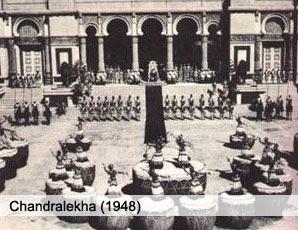
Chandralekha (1948) - Did roaring business across the country, both in Tamil and Hindi. Gemini boss SS Vasan spared no expenses for this costly spectacle. Remembered for the elaborate drum dance
Velaikkari (1949)- based on CN Annadurai's play, scripted by Anna. The film's release coincided with the founding of the DMK, and dramatised the fledgling party's anti-caste, anti-Brahmin ideology
Parashakti (1952) - Sivaji Ganesan's stirring debut. Karunanidhi pens long-winded Dravidian ideology dialogues, in line with DMK policy
Nadodi Mannan (1958) - Produced and directed by MGR. Period adventure fantasy with DMK symbols thrown in.
Commercial success was followed by a public reception for MGR by the DMK, taking him in procession in a chariot drawn by four horses, thronged by people. The chariot had the background of a rising sun on a lotus.
There was no turning back for the future Chief Minister
Apoorva Ragangal (1975) - Radical theme with an older man falling for a much younger woman and a younger man having a relationship with a much older woman. K Balachander gave Kamal Haasan his big break as a lead actor and Rajinikanth his first-ever film role
Nayakan (1987) - Mani Ratnam's Godfather saga with Kamal Haasan. Made it to Time magazine's list of top 100 films. Ratnam's imaginative song picturisation skills in evidence (honed to perfection in his later films) especially in the Holi song. Great music by Ilaiyaraaja
Roja (1992) - Breathtakingly simple and beautiful, Vairamuthu's lines Chinna Chinna Aasha struck a chord all over. The A R Rahman star was born, marking the end of Ilaiyaraaja's overwhelming dominance in film music. Ilaiyaraaja never composed for Mani Ratnam again. After the days of Chandralekha, the first Tamil film to grip the entire nation. A well-crafted drama coming in the wake of high-profile kidnappings in Kashmir.
Kaadhalan (1994) - Prabhudeva's dancing skills in Chikku Bukku Chikku Bukku (Gentleman) had already gripped the South. Here was the rubber man as a hero for the first time. With Rahman's music and Prabhdeva's twists and turns, Kaadhalan was a rage. Director Shankar's formula of extravagant song sequences and massive budgets took firm expression
Baasha (1995) - Loosely inspired by Amitabh Bachchan's Hum (also starring Rajini), Baasha's stupendous success ensured Rajinikanth became a demigod from just a superstar. Each Rajini release thereafter was a gala event in itself. He could afford to take his time, carefully choose his films and needed to have only an average of one release in two or even three years.
Kaaka Kaaka (2003) - Signature statement of the brave new world of Tamil cinema, as the post-Rajni and Kamal generation stood up to be counted. A brutal and gritty cop film which resisted a conventional end. Surya made his mark, amply backed by technical finesse and slick editing
This is my list of the 10 most influential Tamil fims, and they need not and will not match with the best 10 Tamil films ever made. Here I submit that I haven't seen enough Tamil cinema to come up with a rating of the very best.

Chandralekha (1948) - Did roaring business across the country, both in Tamil and Hindi. Gemini boss SS Vasan spared no expenses for this costly spectacle. Remembered for the elaborate drum dance
Velaikkari (1949)- based on CN Annadurai's play, scripted by Anna. The film's release coincided with the founding of the DMK, and dramatised the fledgling party's anti-caste, anti-Brahmin ideology
Parashakti (1952) - Sivaji Ganesan's stirring debut. Karunanidhi pens long-winded Dravidian ideology dialogues, in line with DMK policy
Nadodi Mannan (1958) - Produced and directed by MGR. Period adventure fantasy with DMK symbols thrown in.
Commercial success was followed by a public reception for MGR by the DMK, taking him in procession in a chariot drawn by four horses, thronged by people. The chariot had the background of a rising sun on a lotus.
There was no turning back for the future Chief Minister
Apoorva Ragangal (1975) - Radical theme with an older man falling for a much younger woman and a younger man having a relationship with a much older woman. K Balachander gave Kamal Haasan his big break as a lead actor and Rajinikanth his first-ever film role
Nayakan (1987) - Mani Ratnam's Godfather saga with Kamal Haasan. Made it to Time magazine's list of top 100 films. Ratnam's imaginative song picturisation skills in evidence (honed to perfection in his later films) especially in the Holi song. Great music by Ilaiyaraaja
Roja (1992) - Breathtakingly simple and beautiful, Vairamuthu's lines Chinna Chinna Aasha struck a chord all over. The A R Rahman star was born, marking the end of Ilaiyaraaja's overwhelming dominance in film music. Ilaiyaraaja never composed for Mani Ratnam again. After the days of Chandralekha, the first Tamil film to grip the entire nation. A well-crafted drama coming in the wake of high-profile kidnappings in Kashmir.
Kaadhalan (1994) - Prabhudeva's dancing skills in Chikku Bukku Chikku Bukku (Gentleman) had already gripped the South. Here was the rubber man as a hero for the first time. With Rahman's music and Prabhdeva's twists and turns, Kaadhalan was a rage. Director Shankar's formula of extravagant song sequences and massive budgets took firm expression
Baasha (1995) - Loosely inspired by Amitabh Bachchan's Hum (also starring Rajini), Baasha's stupendous success ensured Rajinikanth became a demigod from just a superstar. Each Rajini release thereafter was a gala event in itself. He could afford to take his time, carefully choose his films and needed to have only an average of one release in two or even three years.
Kaaka Kaaka (2003) - Signature statement of the brave new world of Tamil cinema, as the post-Rajni and Kamal generation stood up to be counted. A brutal and gritty cop film which resisted a conventional end. Surya made his mark, amply backed by technical finesse and slick editing
This is my list of the 10 most influential Tamil fims, and they need not and will not match with the best 10 Tamil films ever made. Here I submit that I haven't seen enough Tamil cinema to come up with a rating of the very best.
Sunday, August 19, 2007
A PIECE OF CAKE
Rising India, Emerging India or India Shining. Spin it whichever way, there's money to flaunt and splash, as a burgeoning middle-class lets itself loose.
In an EMI-driven era, getting a housing loan, car loan or a personal loan has become a piece of cake. But what took the cake for me today was an Indian Express story which said banks have started giving loans to doting parents for kids' birthday bashes. Marriages, it's easy to relate to, but bank loans and EMIs for birthdays!
Parents are free to indulge their kids, using their resources. But bank loans for birthdays? Seems more like the outcome of peer pressure for both parents and kids. And a means to network for both parents and guests.
Here's more courtesy Washington Post
Being in India, one is used to the dichotomy of grinding poverty and staggering affluence. But in this India of opportunities for the middle class, the gap between the kid blowing up three lakhs on a birthday and the kid doing cartwheels and twisting her body while begging near Connaught Place is clearly widening. Emerging India is indeed appealing and scary at the same time.
In an EMI-driven era, getting a housing loan, car loan or a personal loan has become a piece of cake. But what took the cake for me today was an Indian Express story which said banks have started giving loans to doting parents for kids' birthday bashes. Marriages, it's easy to relate to, but bank loans and EMIs for birthdays!
Parents are free to indulge their kids, using their resources. But bank loans for birthdays? Seems more like the outcome of peer pressure for both parents and kids. And a means to network for both parents and guests.
Here's more courtesy Washington Post
Being in India, one is used to the dichotomy of grinding poverty and staggering affluence. But in this India of opportunities for the middle class, the gap between the kid blowing up three lakhs on a birthday and the kid doing cartwheels and twisting her body while begging near Connaught Place is clearly widening. Emerging India is indeed appealing and scary at the same time.
Subscribe to:
Posts (Atom)


